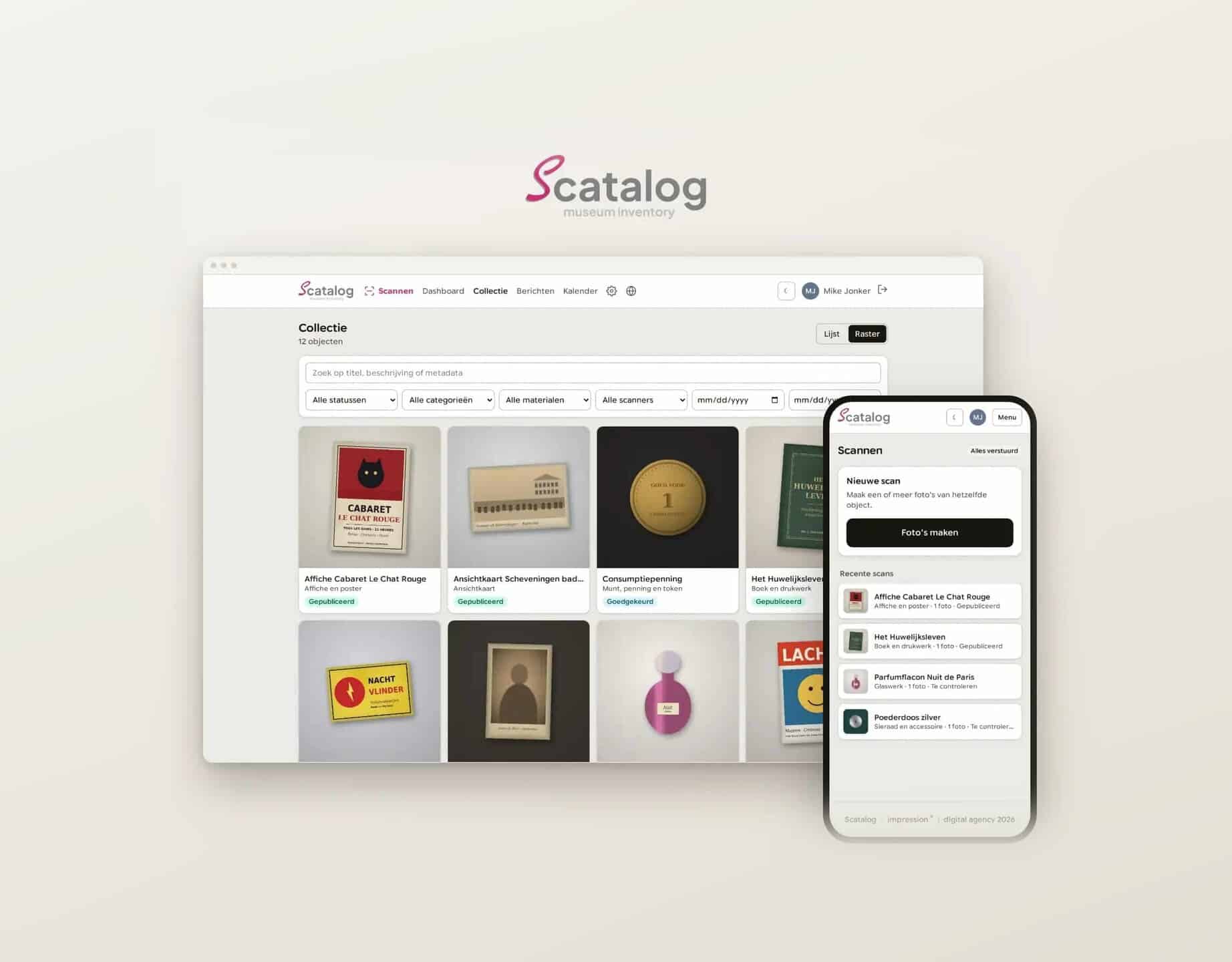
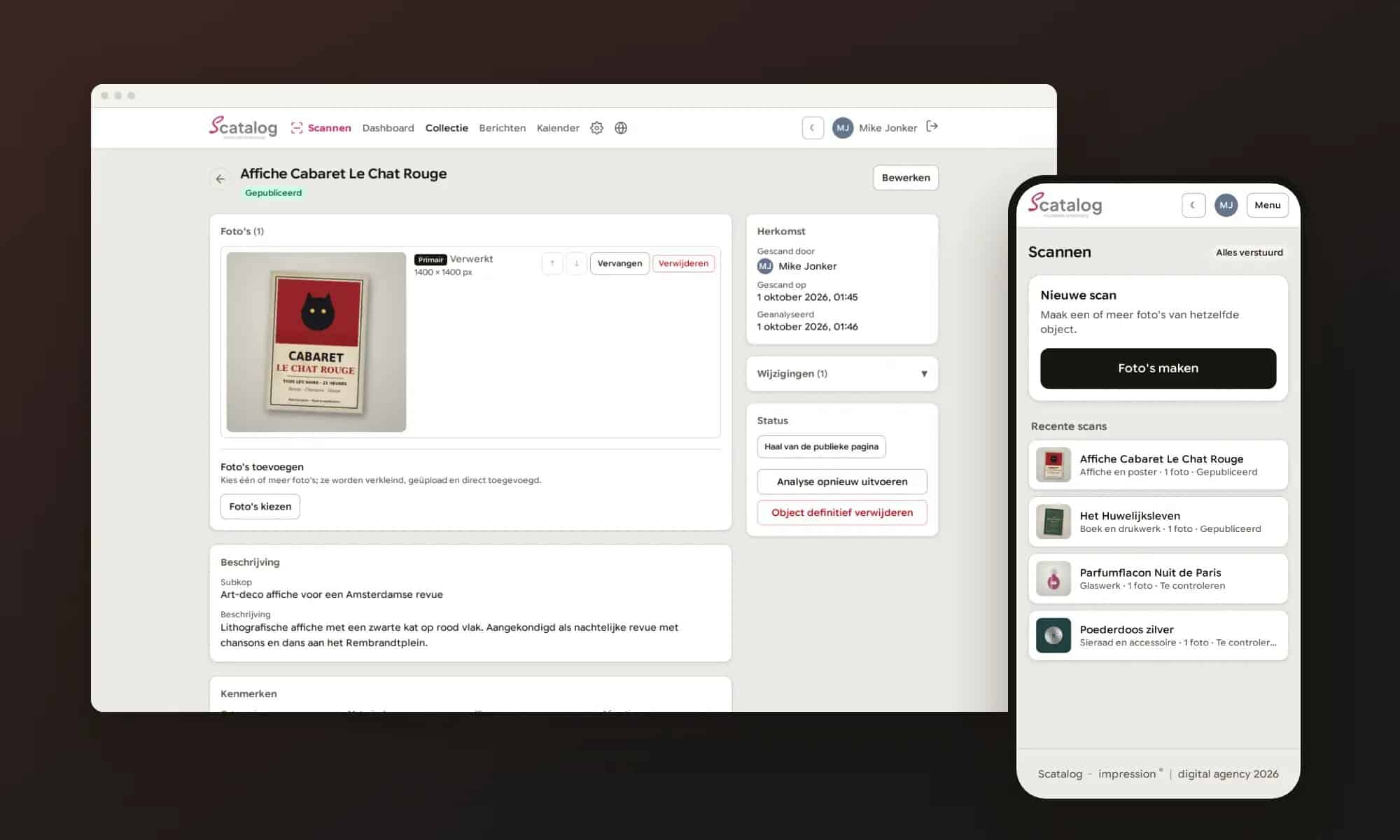
The Museum Amsterdam has an enormous collection: posters, postcards, books, glassware, vinyl records and thousands of small objects. Many of these were not digitally recorded anywhere. With Scatalog that changes. An employee photographs an object with their phone, AI writes a title, subtitle and brief description and shares it online. The team checks, adds and publishes it in one click.
Scatalog consists of two parts. The scan app works on the iPhone and is deliberately simple: take a photo, send it, then move on to the next object. If the connection drops in the repository, the scans remain in a queue and will be uploaded later. Photos are converted in the background to light WebP files.
In the management platform, the team views the entire collection as a list or grid. Each object has a status: concept, to be reviewed, approved, or published. Researchers improve the description, add material, period, dimensions, and location in the museum, and in the history they see who has made what changes. Scanners, researchers, and administrators each have their own rights, and logging in involves two-step verification.
Publicly available objects are accessed via a dedicated link on the museum website. We built Scatalog in Laravel and Livewire, with hundreds of automated tests. This is how we use AI: taking the boring work out of it, letting people decide.
Ready for the next step?
Do you want a project like that too? Tell us what you want to achieve.
A 30-minute conversation. No sales pitch, just honest advice and a fixed price if you want to continue.